HR Solutions, New deal for working people: Planning for change
Here is the Hot Topic for December 2025 and an accompanying webinar, will be held on 11 December 2025.
1. Introduction
At this time of year, it is always a good time to reflect on the past year and to plan for the next. With 2026 set to see the most significant developments in employment law, that has been seen in decades, we consider the important steps that will help businesses to plan for change.
2. Legislation Timeline
2026 is expected to be an extremely busy time for employers with the first few phases of the Employment Rights Bill (likely to become known as the Employment Rights Act 2025) being introduced. This is in addition to various other pieces of legislation.
We illustrate below changes in employment law expected in 2026. Full details are provided on the Knowledge Base, see our ERB News Hub for the latest information.
This table provides a summary of the developments in employment law in 2026
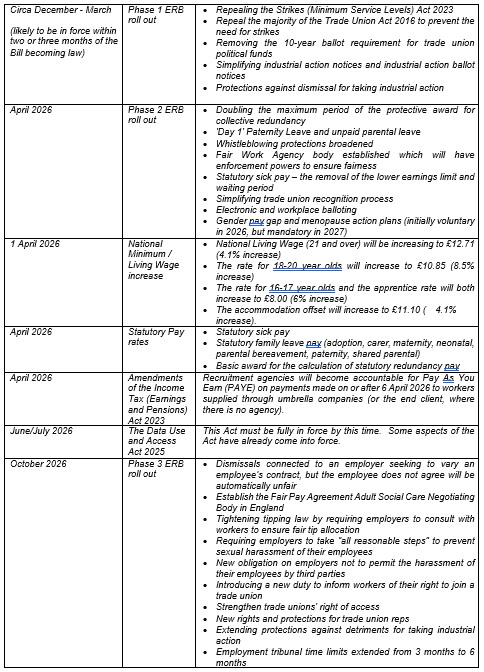
Employment developments for 2027 and beyond can be found in our Knowledge Base article ‘Employment Law Timetable’.
One significant change to note, as this concerns one of the biggest reforms under the ERB, is regarding the reform to remove the two-year qualifying service to claim unfair dismissal.
Whilst this reform was not scheduled to be introduced until 2027 onwards, the recent announcement by the Government on 27 November 2025 that they will instead amend this to require an employee to have six months service to claim unfair dismissal, will be welcome news to all employers. You can read our latest news report on this significant development on our ERB New Hub.
3. Employment in 2026
Employers’ priority for 2026 must be for legal compliance; a failure in doing so presents significant risk. With the changing employment landscape, the employment reforms will have far reaching consequences on workplace culture. In this section we examine the latest view on the labour market and workforce confidence, along with HR trends. Both of which play a pivotal role in driving workplace change and effective business operations.
HR Trends
It perhaps is no surprise that Artificial Intelligence (AI) continues to be a core business function; but this isn’t the only area of significant trend, below, we share our 5 top HR trends for 2026.
1) AI – from experimentation to core business function
AI is moving from a peripheral tool to a core business function embedded across HR tasks such as recruitment, learning and performance. The key priority is responsible AI deployment, focusing on governance, ethics, and fairness. HR leaders must act as digital partners, balancing human judgment with AI efficiency.
2) Skills based hiring, development and workforce fluidity
There is a growing shift from traditional credentials like degrees, CV history toward skills-based hiring and internal mobility, emphasising soft skills and actual competencies. L&D is evolving toward micro-learning and community-driven knowledge sharing and the workforce is becoming more fluid through project-based, gig-style practices, which all demand flexibility and adaptability.
3) People centred employee experience and wellbeing
With rising employee expectations and a competitive job market, employee experience (i.e., well-being, purpose, inclusion) is the core differentiator. Leadership is shifting to emphasise empathy and psychological safety with HR's role transforming from administrative/compliance to strategic, driving culture, retention, and environmental, social and governance considerations (ESG).
4) Flexible structure, agility and cross functional HR
Traditional HR silos (recruitment, L&D, performance etc) are declining and instead, the function is moving toward cross-functional teams which manage the integrated employee lifecycle. Roles are becoming more modular and fluid, requiring HR to orchestrate agile structures through rapid reskilling, hybrid roles, and project-oriented teams. HR functions are becoming more strategic and tightly linked to overall business goals.
5) Data driven decision making
The use of HR analytics and predictive workforce planning is rising. This analytical shift enables organisations to proactively anticipate skills gaps and turnover risk, aligning workforce strategy with business needs for smarter talent management and retention.
Labour market and workforce confidence
The UK's employment legislative framework is undergoing significant change, necessitating that employers consider reforms alongside current and forecasted labour market conditions.
This section summarises cross-economy business views on the UK labour market from the CBI and Pertemps Network Group's 2025 Employment Trends Survey, which assesses jobs, pay, competitiveness, and skills relative to economic growth.
Key findings on legislative impact:
The survey reveals widespread business concern regarding the affordability and impact of the Employment Rights Bill (ERB):
Affordability concern: 78% of businesses worry they cannot afford the ERB changes without negatively affecting growth, jobs, investment, or discretionary employee benefits (a 54% increase from last year).
Strong disagreement: 48% of respondents strongly disagree that the Bill will be affordable without unintended consequences (a doubling from last year).
Threat to competitiveness: 53% cite the ERB as the second biggest threat to business competitiveness.
Workforce reduction: 27% of businesses intend to reduce their workforce size rather than grow it.
This legislative and economic outlook means SMEs in the UK face a period of heightened cost pressure, administrative complexity, and legal risk going into 2026.
The sentiment that 78% of businesses worry they cannot afford the ERB changes is particularly acute for SMEs, which typically operate with lean resources and no dedicated HR/Legal teams.
This is significant, given that of the 1.4 million private sector employing businesses, over 99% are SMEs, with 1.15 million micro businesses (1-9 employees), 220,085 small businesses (10 – 49 employees) and 38,435 medium sized businesses (50-249 employees). The smaller the business, the bigger the impact on both operations and employee stability.
4. Strategic HR Plan
For 2026, HR priorities must strategically balance legal compliance with the latest HR trends and labour market dynamics.
Developing an aligned HR strategy and People Plan is essential. Amid economic uncertainty, this strategy must link directly to business goals and external factors.
This planning activity allows businesses to identify and mitigate internal and external threats/weaknesses while leveraging strengths and opportunities, supporting the business against heightened cost pressure, administrative complexity, and legal risk.
Developing an aligned HR strategy and People Plan is a proactive process that ensures your workforce can achieve the overall business strategy and goals. It shifts HR from simply administering tasks to being a strategic driver of growth and resilience, especially important given the current economic and legislative uncertainties.
You can find out more about how to develop an aligned HR strategy and People Plan in our Knowledge Base article.
5. Further Information
The Knowledge Base is your central point for accessing articles and employment templates. Our ERB News Hub contains the latest developments regarding the Employment Rights Bill and our monthly newsletter is another key tool for staying up to date on general HR trends and news, enabling the business to prepare for the year ahead.
At the top of this Knowledge Base article, you will find all associated articles to this topic, along with document templates.